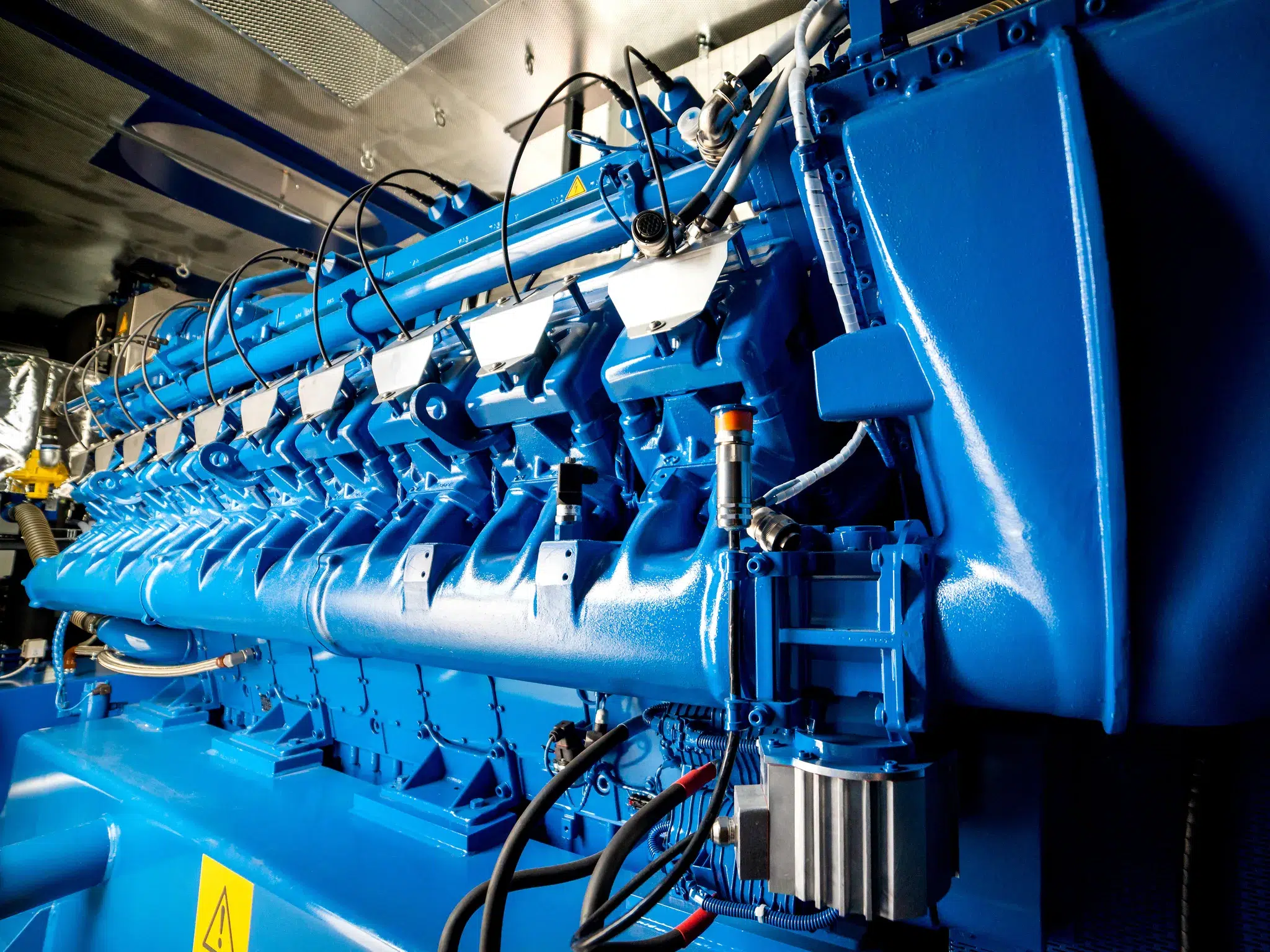
A reliable industrial generator maintenance schedule keeps the system inspected, tested, and serviced before an outage puts it to work.
This guide walks through the full maintenance framework so facility managers and operations teams know exactly what needs to happen, how often, and why it matters.
Industrial Generator Maintenance Schedule by Interval
An industrial generator maintenance schedule should be organized by frequency, with daily or weekly visual checks, monthly operational testing, semi-annual service, annual maintenance, fuel testing, and load bank testing when required or recommended.
| Maintenance Interval | What to Check | Why It Matters |
| Daily/Weekly | Fluid levels Leaks Alarms Battery charger Fuel level Auto mode | Catches small issues |
| Monthly | Exercise run Gauges Operating temperature, Voltage Electrical frequency Automatic Transfer Switch (ATS) function | Confirms the system can start, run, and stabilize |
| Semi-Annual | Belts Hoses Batteries, Wiring Corrosion Connections Block heater | Reduces mechanical and electrical failure risk |
| Annual | Oil Filters Coolant Fuel analysis Exhaust inspection Load bank testing | Verifies readiness and supports documentation |
The right schedule depends on:
- Generator type
- Site risk profile
- Manufacturer requirements
- Runtime hours
- Fuel type
- Whether the system supports emergency, standby, or prime power
A generator can start during a quick test and still have issues that do not show up until the system is under real load.
Our facility maintenance team can help you build a schedule that aligns with your equipment, risk tolerance, operating environment, and applicable compliance requirements.
Industrial Generator Maintenance Checklist by Task
A generator maintenance checklist should be organized by system. This makes it easier for facility managers to assign tasks across teams and catch what’s overdue.
Engine and Fluids
- Check oil level and condition.
- Check coolant level and signs of leakage.
- Inspect belts, hoses, clamps, and visible wear.
- Review operating temperature during exercise runs.
Fuel System
- Check fuel level.
- Look for water, sediment, or contamination.
- Schedule fuel analysis, polishing, or stabilizing additives when needed.
- Replace fuel filters according to the maintenance plan.
Battery and Starting System
- Confirm battery charger operation.
- Check battery terminals for corrosion.
- Test battery conductance or specific gravity when appropriate.
- Confirm the generator starts reliably during scheduled testing.
Electrical and Transfer Equipment
- Verify voltage and frequency.
- Review control panel alarms or fault codes.
- Inspect wiring and visible connections.
- Test Automatic Transfer Switch operation when scheduled.
Documentation
- Record inspection dates, run times, test results, issues found, corrective action taken, and service dates.
- Keep records organized for inspections, audits, insurance reviews, and internal facility documentation.
Our commercial electrical and facility maintenance teams follow this structure during scheduled visits, so your records and our service notes stay consistent.
Daily and Weekly Generator Inspection Checklist
Daily or weekly generator inspections should check for visible leaks, fluid levels, battery charger status, control panel alarms, unusual smells, blocked airflow, and whether the generator is set to Auto mode.
These walkthroughs help facility teams catch visible issues between professional service visits. They’re quick, but they can reveal problems that may prevent the generator from starting or transferring power correctly.
Look, Listen, Smell
- Look for fluid staining, low oil or coolant readings, low fuel, active alarms, blocked intake or exhaust areas, and signs of rodent activity.
- Listen for vibrations, knocking, or engine sounds during exercise runs that differ from normal.
- Smell for fuel near the unit (indicating a leak) or an ozone or electrical smell (requires immediate attention).
Additional Weekly Checks
- Battery charger indicator is active and reading correctly.
- Transfer switch is set to Auto, not Manual or Off.
- Exhaust area is clear of debris and obstructions.
Your team can handle these walkthroughs internally, or we can fold them into a facility maintenance plan that covers everything from routine checks to deeper service work requiring specialized equipment and diagnostic tools.
Monthly Emergency Power System Maintenance
Monthly generator maintenance should confirm that the unit can start, run at the right temperature, and transfer load correctly.
A monthly run should allow the engine to reach the full manufacturer-recommended operating temperature, which typically requires a sustained run time rather than a quick start-and-stop.
Running a diesel generator under little or no load can lead to wet stacking, where unburned fuel and carbon accumulate in the exhaust system. Wet stacking increases wear and can eventually require more extensive repairs.
One of our facility maintenance technicians explains:
“Temperature is where a lot of monthly maintenance falls short. If the engine never gets up to operating temp, you’re not really testing it, you’re just burning fuel.”
Monthly checks should also include the Automatic Transfer Switch (ATS). The ATS shifts your building from utility power to generator power when the grid goes down.
We often recommend monthly professional inspections for commercial facilities with standby or emergency power systems.
That said, our facility maintenance plans are customized around your equipment and schedule, so if monthly visits aren’t the right fit for your site, we’ll tell you that too.
What Happens During Professional Generator Service
Semi-annual and annual generator service often includes hands-on inspection and testing of components that wear, loosen, corrode, or weaken between visits.
Semi-Annual Service
- Belt tension, which affects cooling and charging when loose or worn
- Hose condition for signs of brittleness or softness in coolant and fuel lines
- Battery conductance or specific gravity testing to confirm reliable cold-start performance
- Electrical connections checked for corrosion, loosening, or heat damage
- Block heater operation, especially important heading into cooler months
Annual Service
- Oil and filter change
- Fuel and air filter replacement
- Coolant testing or flush, since coolant degrades chemically regardless of runtime hours
- Exhaust system inspection for cracks or blockages
- Control panel and transfer switch review
Standby generators age from sitting as much as from running. Moisture, battery degradation, fuel instability, corrosion, and temperature fluctuations can all cause problems even when the hour meter reads low.
Our facility maintenance team can incorporate generator service into your broader maintenance plan so it’s not being tracked separately from the rest of your critical building systems.
Load Bank Testing for Commercial Generators
Load bank testing verifies that a commercial generator can carry a controlled electrical load and perform under the kind of demand it may face during an outage.
A load bank is an external device that applies a controlled electrical demand to the generator, separate from whatever the building is drawing at the time. That allows the test to confirm whether the engine responds correctly under increasing load, holds voltage and frequency in range, and can actually deliver its rated capacity.
Building load alone usually isn’t enough for a real test. Standby lighting and heating or A/C equipment don’t come close to simulating a full facility coming back online after an outage.
Resistive load banks simulate that demand. Reactive load banks add the inductive load that reflects motors and compressors, which is the more relevant test for hospitals, data centers, and manufacturing operations.
Our commercial electrical team performs load bank testing as part of our generator maintenance services and can point you toward the right approach for your situation.
Fuel Quality Management for Standby and Prime Power Generators
Bad fuel is one of the more common reasons a generator fails at startup, and it’s one of the harder problems to spot without actually testing the fuel.
Ultra-Low Sulfur Diesel breaks down faster in storage than older diesel formulations. After six months in a tank, it can degrade to the point of clogging filters, causing poor combustion, and preventing a reliable start.
A fuel management plan covers:
- Annual fuel analysis
- Water separator checks
- Fuel polishing when contamination is found
- Stabilizing additives for stored fuel
- Tank inspection for corrosion and sediment
Common Fuel Problems in Standby Generators
- Water accumulation from condensation
- Microbial growth at the water-fuel interface
- Oxidation byproducts that reach injectors
- Incomplete combustion from degraded fuel
When our team is on-site for scheduled generator maintenance, fuel condition is always part of the evaluation.
NFPA 110 Generator Testing Requirements and Documentation
NFPA 110 generator testing requirements focus on demonstrating that emergency and standby power systems can start, transfer power, carry load, and remain documented in accordance with the system’s classification.
The standard divides systems into two levels based on the consequences of failure:
- Level 1 applies when a failure creates a serious life-safety risk (hospitals, surgical centers, and facilities where loss of power puts people in direct danger). These systems face more frequent testing requirements, tighter transfer-time tolerances, and thorough recordkeeping obligations.
- Level 2 covers situations where failure is less likely to pose an immediate life-safety risk but still causes significant operational disruption. Data centers, manufacturing plants, and commercial facilities often fall under this category, though the actual designation depends on the application and how the system is used.
Verify requirements against the currently adopted code, the local authority having jurisdiction (AHJ), and any applicable mandates from accreditation bodies or insurers, since requirements vary by state and jurisdiction.
The 2026 NFPA 110 generator testing requirements include updated language around documented readiness, which is where facilities tend to run into trouble.
Inspectors expect to see:
- Maintenance logs
- Test results
- Identified deficiencies
- Corrective actions
- Service dates
One of our facility maintenance technicians shared a common experience:
“I’ve walked into plenty of facilities where the generator runs fine, but the logbook is basically empty. That’s what gets people in trouble during an inspection. They want a paper trail going back years. If you can’t show them that, it doesn’t matter how well the generator performed that morning.”
Our emergency generator maintenance services include recordkeeping at every visit, so when an inspection or audit comes up, the documentation is already organized and ready.
The Benefits of Remote Generator Monitoring and Real-Time Maintenance Alerts
Remote generator monitoring improves emergency power system maintenance by alerting facility teams to problems before the next inspection, service visit, or outage.
Telemetry hardware can track battery voltage, charger status, fuel level, coolant temperature, fault codes, run status, and ATS transfer events in real time. When something falls outside normal range, an alert can notify your team or service provider.
This means better visibility between scheduled visits. Our technicians can also use that same data when responding to service calls, so they arrive with fault history already reviewed and the right parts ready.
For facilities that want stronger system visibility across critical equipment, our Smart Buildings Group can help connect monitoring, alerts, and building data into a more proactive maintenance approach.
Reliable Backup Power Starts With a Maintenance Plan You Can Document
A generator that gets consistent, documented maintenance is one you can actually count on when the power goes out. The facilities that run into trouble are usually the ones where service was handled inconsistently or never properly recorded.
A facility maintenance agreement with us takes the scheduling, recordkeeping, and technical service off your plate.
Contact us to schedule a generator inspection or to build a maintenance plan tailored to your facility’s specific needs.
Industrial Generator Maintenance FAQs
How often should an industrial generator be serviced?
An industrial generator should typically receive routine weekly visual checks, monthly operational testing, semi-annual deeper mechanical and electrical service, and full annual service, including fluid and filter replacements. The exact schedule depends on system classification, manufacturer requirements, runtime hours, and any code or accreditation requirements.
Do commercial generators need load bank testing every year?
Annual load bank testing is particularly valuable for generators supporting data centers, healthcare facilities, manufacturing facilities, or any site where normal building load doesn’t adequately exercise the generator near its rated capacity.
Whether it’s required annually depends on the system classification, operational risk, and applicable compliance requirements.
What causes most generator failures?
Common failure points include battery degradation, old or contaminated fuel, coolant system issues, blocked intake or exhaust areas, Automatic Transfer Switch problems, and gaps in documented maintenance. Many of these conditions are preventable with consistent inspections and professional service.