If you’re looking for electrical maintenance strategies to reduce downtime, start with your highest-risk equipment: Switchgear, transformers, transfer switches, backup power systems, and critical panels.
These are the assets most likely to turn a small electrical issue into a building-wide problem.
Once those risks are clear, your maintenance plan can focus on prevention, monitoring, repairs, and faster response when something starts trending the wrong way.
We help facilities turn those moving parts into a practical electrical reliability plan.
Here’s how to build that kind of plan without turning electrical maintenance into another impossible item on your team’s to-do list.
What Electrical Maintenance Strategies Reduce Downtime?
The electrical maintenance strategies that reduce downtime are the ones that help your team identify high-risk equipment, catch warning signs early, fix known issues, and keep clear records of what needs attention next. That means fewer blind spots around the equipment that can trigger lost production, tenant complaints, safety concerns, or after-hours emergency calls.
A strong program usually combines scheduled maintenance with condition-based testing.
- Scheduled maintenance ensures routine inspections and service don’t slip through the cracks.
- Condition-based testing helps your team understand how critical equipment is actually performing between those scheduled visits.
Both are crucial because one annual inspection may catch some issues, but it’s more of a spot check. It might not show how your most important equipment is performing the rest of the year as conditions change and equipment ages.
What to Include in Your Electrical Maintenance Strategy
- Critical asset inspections, especially for the equipment your building cannot afford to lose
- Switchgear and transformer testing to check the main electrical equipment feeding your facility
- Transfer switch and backup power maintenance to make sure generators can support the building during an outage
- Commercial building power quality monitoring to catch voltage problems, surges, and other issues that can damage sensitive equipment
- Infrared and ultrasonic testing to find heat, arcing, or hidden warning signs before equipment fails
- Electrical diagrams and accurate panel labels that match the building as it exists today (especially important if the building has undergone renovations)
- A repair log and follow-up plan so that known issues are addressed before they cause outages
Based on our service history, repeat electrical failures tend to show up at some of the same facilities each year. Grocery stores account for roughly 5% to 10% of the sites where we see multiple electrical failures, likely because refrigeration, lighting, controls, and customer-facing operations are always in use.
That’s why the best maintenance strategy isn’t built around a generic checklist alone. It should also account for how much strain your facility puts on its electrical system day after day.
We support facilities with hands-on maintenance and 24/7 service, helping you move from scattered electrical fixes to a maintenance plan built around uptime, safety, and real operational risk.
The New Standard: NFPA 70B and the Condition of Maintenance
NFPA 70B is the electrical maintenance standard that helps facilities develop a more formal maintenance program focused on safety, reliability, and equipment condition. NFPA 70B was previously treated as recommended guidance. If the lights were on and the equipment seemed fine, deeper testing could be pushed aside by more visible problems.
In 2023, NFPA 70B shifted from a recommended practice to a standard, which raised the bar for how facilities plan their electrical maintenance programs.
The 2026 edition continues that push toward more structured maintenance, including stronger attention on equipment condition, monitoring, and the systems that support uptime.
How Condition-Based Maintenance Fits NFPA 70B
NFPA 70B pushes facility teams to think beyond whether equipment is simply “working today.” The better question is whether that equipment is showing early signs of stress, and that’s where the P-F Curve becomes useful.
The P-F Curve tracks the time between the first sign of trouble and the point where equipment can no longer do its job:
- Potential failure: The first detectable sign that something is wrong, such as heat, noise, vibration, arcing, corrosion, or an abnormal test result
- Functional failure: The point where the equipment fails or can no longer support the load safely and reliably
Good maintenance happens between those two points.
If your team only finds the issue after power drops, production stops, or backup power doesn’t respond, the equipment has already crossed into functional failure.
We help facilities use testing, documentation, monitoring, and a thorough electrical inspection checklist to make maintenance more specific to the building.
That gives you a clearer record of what was checked, what changed, what needs repair, and what should be watched before the next failure.
Preventive vs. Predictive Electrical Maintenance: Which Strategy Works Best?
A hybrid maintenance strategy for your electrical system usually works best because it combines scheduled service with condition-based testing.
Preventive maintenance handles routine tasks your facility needs on a set schedule. Predictive maintenance uses testing, monitoring, and data to catch hidden problems before they turn into downtime.
| Strategy | What It Means | Best For | Limitation |
| Preventive maintenance | Scheduled cleaning, inspections, tightening, testing, and breaker exercising. | Routine upkeep, compliance records, and known maintenance tasks. | Can miss issues that develop between visits. |
| Predictive maintenance | Testing and monitoring equipment condition using data and diagnostic tools. | Critical assets, high-uptime facilities, and equipment showing early warning signs. | Requires the right tools, analysis, and follow-up. |
| Hybrid maintenance | Using scheduled service plus condition-based testing. | Commercial, healthcare, industrial, and institutional buildings where downtime is expensive. | Requires coordination between inspections, monitoring, repairs, and documentation. |
When you’re responsible for a building that cannot afford surprise outages, our facility management services and smart building solutions help connect scheduled service, monitoring data, and repair planning, so your team has a clearer path from finding a problem to fixing it.
High-ROI Predictive Technologies for 2026
The predictive technologies that often deliver the strongest return are those that help teams identify problems before a forced shutdown happens. Continuous thermal monitoring, ultrasonic testing, and power quality analysis can help flag heat, arcing, voltage issues, and other early warning signs before they become emergency repairs.
These tools are valuable because many serious electrical issues are invisible during a basic walkthrough.
Continuous Thermal Monitoring
Continuous thermal monitoring watches for heat buildup inside critical electrical equipment. Heat is often one of the earliest signs of a loose connection, an overloaded circuit, a failing component, an unbalanced load, or a developing fault. Used alongside an annual thermographic survey, it gives facility teams a better chance of catching issues before a failure affects the site.
Ultrasonic Testing
Ultrasonic testing listens for electrical problems you may not be able to see yet. Arcing, tracking, and corona discharge can produce high-frequency sounds that help qualified technicians spot trouble inside energized or enclosed equipment.
Power Quality Analysis
Power quality analysis monitors voltage sags, harmonics, imbalance, spikes, and other electrical problems that can damage sensitive systems. “Dirty power” may not always shut down a building immediately, but it can shorten the lifespan of electronics, controls, LED lighting, drives, and building automation systems.
Our smart building work supports this shift toward data-backed decisions with building automation, systems integration, predictive analytics, energy services, monitoring tools, and alerts.
Electrical Assets To Prioritize First
Prioritize electrical assets that could cause site-wide downtime, safety risk, or expensive emergency repairs if they fail. Every wire matters, but not every asset carries the same operational impact.
A simple way to rank priorities is to ask: Which equipment would affect the most people, stop the most work, or create the highest safety risk if it failed?
That usually pushes main distribution equipment, backup power, uninterruptible power supply (UPS) systems, and critical panels to the top of the list.
Start with the equipment that supports the largest load or the most critical function:
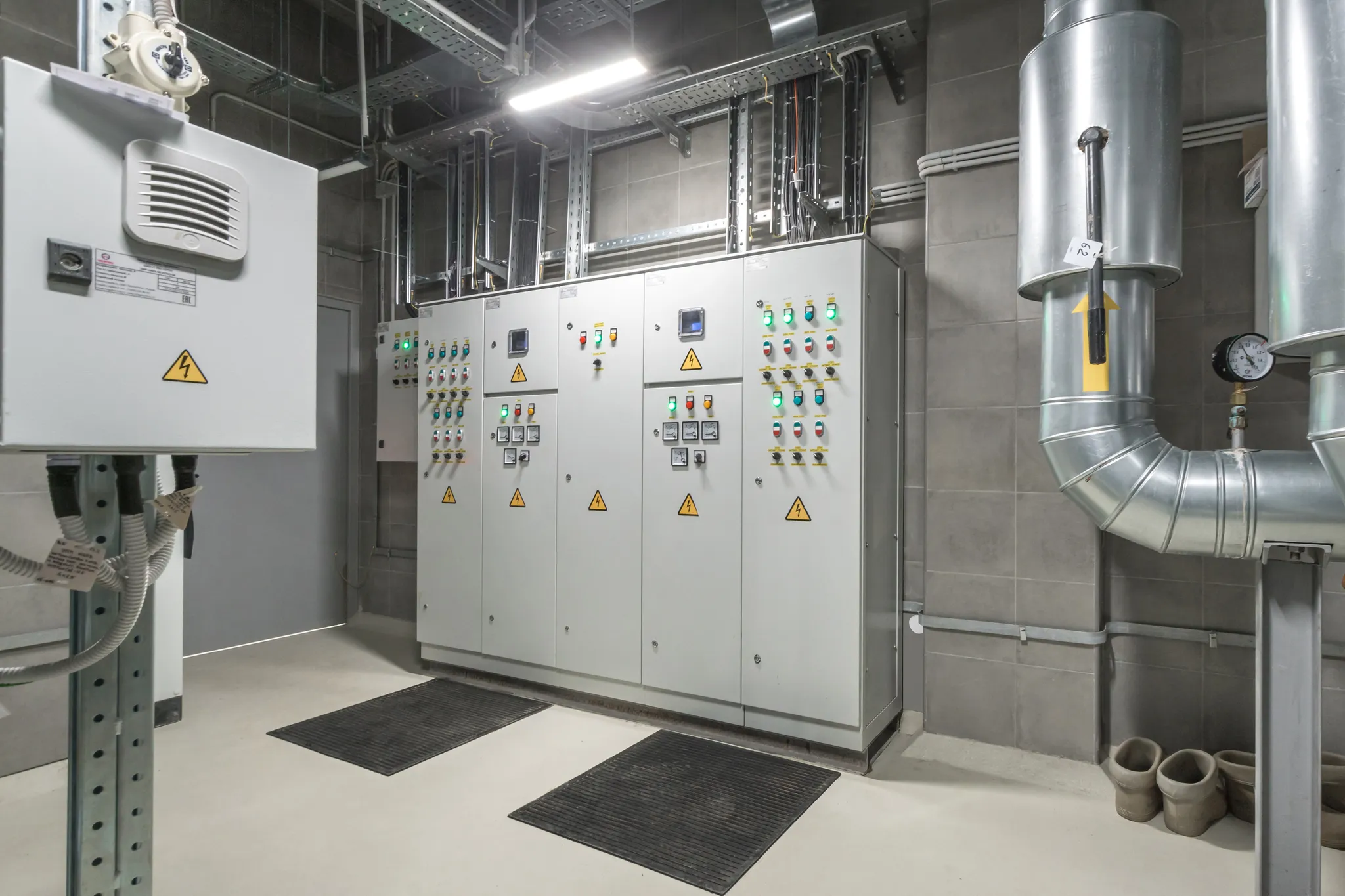
- Main switchgear and distribution equipment
- Transformers
- Automatic transfer switches
- Emergency generators and backup power systems
- UPS systems
- Critical panels, breakers, feeders, and branch circuits
- Lighting controls, safety systems, and building controls
Switchgear
Switchgear maintenance should include visual inspections, cleaning, infrared testing, breaker testing, connection checks, labeling, and documentation. A switchgear issue can affect large areas of the building, so it deserves more than a quick visual check.
Transformers
Dry-type transformers need coil inspections, ventilation checks, load reviews, dust removal, and heat monitoring. Liquid-filled transformers may also require oil analysis, leak inspections, temperature review, and insulation condition checks.
Transfer Switches
Transfer switches need regular maintenance because backup power only works if the switch performs correctly during an outage. A generator may be ready, but a failed transfer switch will leave the building exposed when utility power drops.
Our facility services include electrical maintenance, emergency generator support, backup power support, safety inspections, energy audits, and 24/7 service for commercial facilities.
How Electrical Maintenance Supports Facility Safety
A well-maintained electrical system is safer for your employees, your customers, and the people who service your facility. Breakers, switches, labels, and diagrams all play a role in helping qualified technicians work with the right information and the right protections in place.
Arc flash risk is one example. When breakers are clean, lubricated, and maintained, they can respond faster during a fault, reducing the energy released.
Updated one-line diagrams and clear labeling also support compliance with the latest OSHA requirements and NEC 2026 by making the system easier to identify, isolate, and service safely.
We help facilities strengthen electrical safety through inspections, maintenance, documentation, and repair planning.
Scaling Your Strategy with a Managed Partner
Most in-house teams don’t have unlimited time, specialized testing tools, or extra people waiting around for the next electrical issue. A managed partner helps fill the gaps by connecting inspections, monitoring, repairs, documentation, and emergency response into a plan your team can actually use.
We work with facilities across the Southeast, including commercial, healthcare, industrial, institutional, and government buildings.
For example, our electrical work at the Maury County Justice Center involved a high-visibility public facility with strict schedule, safety, and coordination requirements. The project included power distribution, lighting controls, fire alarm systems, security infrastructure, EV charger support, and close coordination across trades, with on-time delivery and zero safety incidents.
Our support can include facility maintenance, facility management, smart building systems, electrical safety reviews, system monitoring, work order tracking, energy monitoring, backup power support, UPS systems, and emergency service when something needs attention fast.
Since 1944, Lee Company has built a longstanding reputation for reliable service, with licensed and insured technicians and a 4.8-star overall rating from more than 14,000 reviews. Contact us to discuss your facility’s electrical maintenance needs and develop a plan that fits your building’s operations.
Electrical Maintenance FAQ’s for Facilities
How often should commercial electrical equipment be maintained?
Commercial electrical equipment should be maintained based on equipment type, operating conditions, manufacturer guidance, NFPA 70B considerations, and the facility’s risk level. High-load or mission-critical assets may need more frequent inspection, testing, and monitoring than low-risk equipment.
What’s the difference between preventive and predictive electrical maintenance?
Preventive maintenance follows a set schedule, while predictive maintenance uses equipment condition and performance data to predict when service is needed. Most facilities benefit from a hybrid program that includes both to cover routine maintenance and catch hidden failures early.
What causes electrical downtime in commercial buildings?
Electrical downtime is often caused by loose connections, aging equipment, overloaded circuits, poor power quality, failed breakers, transformer issues, or backup power failures. Many of these problems develop long before they interrupt operations, so a combination of preventive and predictive maintenance can help with building uptime.
Why does power quality monitoring matter?
Power quality monitoring helps catch common electrical issues in commercial buildings before they cause a full power outage. Small voltage drops, surges, or uneven power loads can damage controls, lighting, electronics, and other sensitive equipment if they keep happening. Monitoring gives your team a better chance to fix the cause before it turns into repeated failures.